

Autoflower vs Feminized Seeds A Grower’s Ultimate Guide

So, you’re standing at a crossroads, trying to decide between autoflower and feminized seeds. The right choice really comes down to what you’re trying to achieve with your grow. Are you after a quick, simple harvest, or are you in it for the long haul to get the biggest yields and most potent buds possible?
If you want speed and simplicity, autoflowers are your best bet. They let you squeeze in multiple harvests in a single season with very little drama. On the other hand, if your goal is to maximize your harvest, push potency to its limits, and have total control over your plants with advanced training, feminized photoperiod seeds are the way to go.
Understanding Your Primary Seed Options
Picking the right seed is hands-down the most important decision you’ll make before you even get your hands dirty. It sets the stage for everything that follows—your timeline, how much you can expect to harvest, and even the growing techniques you can use. The whole autoflower vs. feminized debate isn’t about which one is “better,” but which one is better for you and your specific setup.
It’s like choosing between a sprinter and a marathon runner. Both are incredible athletes, but you wouldn’t send a sprinter to run 26 miles, right?
Before we get into the nitty-gritty of genetics and growth cycles, let’s lay down a simple foundation.
- Autoflower Seeds: Think of these as the “set it and forget it” option. They get their name because they automatically start flowering on their own schedule, a trait they inherited from a tough little cannabis relative called Cannabis ruderalis. They don’t care about light cycles; they flower when they’re ready, which makes them incredibly fast.
- Feminized Seeds: This term just means the seeds are bred to produce only female plants more than 99% of the time—no more worrying about pesky males pollinating your crop. Most feminized seeds are also “photoperiod,” which means you, the grower, have to trigger their flowering phase by changing the light schedule.
The core difference is simple: Autoflowers run on a built-in, unchangeable timer. With feminized photoperiod plants, you are the one holding the stopwatch. That one distinction creates a ripple effect that touches every single part of the growing process.
To put it all into perspective, let’s break it down with a quick side-by-side look.
Autoflower vs Feminized Seeds At a Glance
This table gives you a bird’s-eye view of what makes these two seed types tick. Use it as a quick reference to see which one aligns with what you’re looking for right now. We’ll dive much deeper into each of these points in a bit.
| Characteristic | Autoflower Seeds | Feminized (Photoperiod) Seeds |
|---|---|---|
| Flowering Trigger | Automatic (Based on age) | Light Cycle (Requires 12/12) |
| Total Grow Time | Fast (8-11 weeks) | Flexible (3-6+ months) |
| Average Size | Compact & Discreet | Large & Expansive |
| Yield Potential | Moderate | High to Very High |
| Training Methods | Low-Stress Training (LST) Only | All Training Methods (LST & HST) |
| Beginner Friendliness | Very High | Moderate |
| Cloning Ability | Not Viable | Excellent |
As you can see, the choice isn’t just about personal preference; it’s about matching the plant’s genetics to your space, your timeline, and your experience level. Now, let’s unpack these differences so you can make a truly informed decision.
Understanding the Genetics That Define Your Grow
To really get to the bottom of the autoflower vs. feminized seeds debate, you have to look at their family trees. Each seed type comes with a completely different genetic playbook that controls its entire life, from how it grows to when it starts making buds. One is the result of carefully breeding for female-only plants, while the other brings a wild, tough-as-nails cousin into the genetic mix.
The biggest difference comes down to how each plant knows it’s time to start flowering. This isn’t just a small detail; it’s the core instruction that shapes your entire growing journey.
Feminized Seeds: The Photoperiod Lineage
Feminized seeds come from the classic cannabis bloodlines we all know: Sativa and Indica. For countless generations, these plants learned to live by the seasons, using the changing amount of daylight as their cue to start reproducing.
This genetic switch is called photoperiodism, and it’s what makes them tick. A photoperiod plant will just keep growing bigger and bigger (vegetative growth) as long as it gets plenty of light—usually 18+ hours a day. It’s only when the light schedule gets cut back to mimic the coming of fall—a strict switch to 12 hours of light and 12 hours of total darkness—that it gets the message to start flowering.
This complete reliance on light puts you, the grower, in the driver’s seat. You get to decide exactly when to “flip” the switch to start flowering, which is perfect if you’re trying to grow massive plants with huge yields.
And the “feminized” part? That comes from a smart breeding trick. Growers can gently stress a female plant to make it create pollen that only has female chromosomes. When that pollen is used on another female, the seeds that grow are over 99% guaranteed to be female, so you don’t have to worry about pesky male plants popping up.
Autoflower Seeds: The Ruderalis Revolution
Autoflowers have a totally different origin story. They are hybrids that mix the Sativa and Indica genetics you love with a third, scrappy cannabis variety: Cannabis ruderalis.
Cannabis ruderalis is a tough little plant from the harsh climates of Central Asia and Siberia. In places with short, cool summers, waiting for the light to change was a bad survival strategy. So, instead of depending on light cycles, it evolved to flower based on its age. It races through its life to make seeds before the first frost hits, no matter how many hours of daylight there are.
Modern breeders saw the genius in this and used it to create autoflowers.
- Internal Clock: An autoflower has its own schedule. It will start flowering automatically once it gets old enough, typically just 2-4 weeks after it sprouts.
- Light Independence: You never have to change the light schedule to a 12/12 cycle. In fact, most growers give them 18-20 hours of light every single day to fuel their rapid growth.
- Speed and Resilience: Those Ruderalis genes make for an incredibly fast seed-to-harvest time and give the plants a natural toughness against cooler weather.
Autoflowers are becoming a huge deal in the cannabis world because they flower on their own terms. This unique trait has made them a favorite for both new growers and seasoned pros, especially for indoor setups or in places with short summers. You can learn more about their rise in popularity by checking out the latest seed market report.
A Detailed Comparison of Key Growing Traits
Genetics are one thing, but what really matters is how these seeds perform in your garden. The true story in the autoflower vs. feminized seeds debate unfolds in the grow room, where their unique characteristics shape your entire experience from start to finish. Let’s break down the four big factors: how fast they grow, how much they yield, their overall size, and how well they take to training.
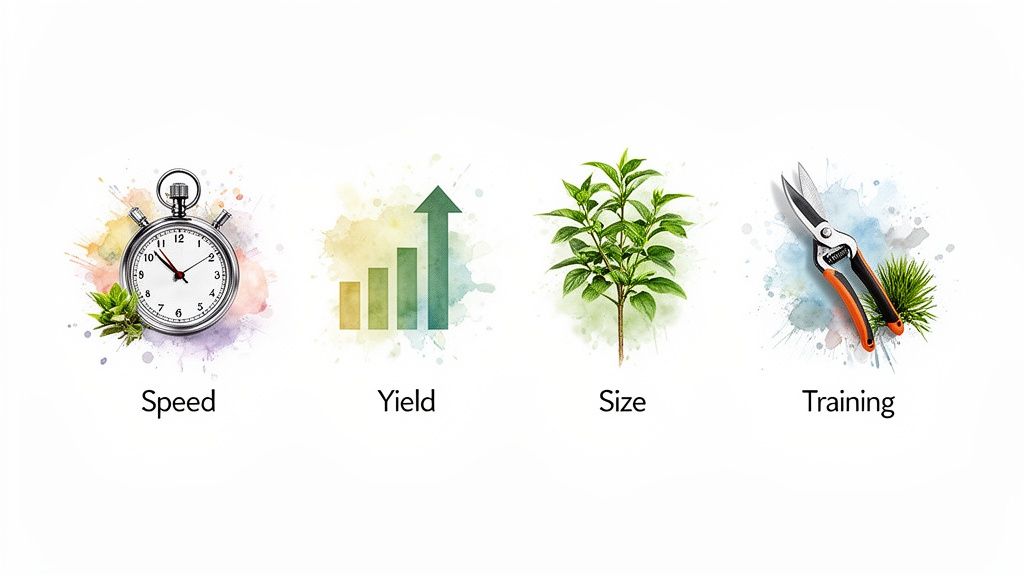
Getting a handle on these differences is the key to matching your expectations with reality. Think of it this way: one seed type is a high-speed sprint to the finish line, while the other is a marathon with a potentially massive prize waiting at the end.
Lifecycle Speed: From Seed To Harvest
When it comes to speed, there’s no contest—autoflowers win, hands down. Their Ruderalis genetics put them on a fixed, unchangeable schedule.
Most autoflower strains will take you from a freshly popped seed to a ready-to-chop plant in just 8 to 11 weeks. This incredible pace makes it possible to pull off multiple harvests in a single outdoor season or run a continuous cycle indoors. They’re perfect for growers who want results, fast.
Feminized (photoperiod) seeds trade that speed for control. Their lifecycle is in your hands, lasting anywhere from 3 to 6+ months because you decide how long the vegetative stage lasts. You can let a plant veg for a month or keep it growing for three before you flip the light schedule to 12/12 and trigger flowering.
The bottom line on speed is simple: Autoflowers are built for a quick turnaround, giving you a fast and predictable harvest. Feminized seeds give you control over the timeline, letting you shape the plant for your specific yield goals.
Yield Potential: How Much Can You Harvest?
This is where feminized seeds really pull ahead. Having the power to extend the vegetative stage means you can grow much larger plants with more branches and, ultimately, more bud sites. It’s a direct path to a bigger harvest.
A well-tended indoor feminized plant can easily produce 4 to 8 ounces or more, and outdoor giants can top a pound. If your primary goal is to get the absolute most out of every single plant, feminized seeds are the way to go.
Autoflowers, with their short lifespan and compact stature, naturally produce more modest yields. A typical indoor autoflower will probably give you somewhere between 1 to 3 ounces per plant. But don’t forget to factor in the time. You can often finish two, maybe even three, full autoflower grows in the time it takes to complete one feminized cycle.
This means that over the course of a year, the total weight you harvest could end up being surprisingly close. It’s a classic trade-off: higher yield per plant (feminized) versus more harvests over time (autoflower).
Plant Size And Space Management
Often, your available space will make the choice for you. The size difference between these two types of plants is significant and has a huge impact on where and how you can grow.
Autoflowers are naturally small and stealthy. They rarely get taller than a few feet, which makes them a perfect match for:
- Small grow tents: Their bushy, compact shape fits perfectly in areas with limited headroom.
- Closet grows: An excellent option for growers needing to keep their hobby on the down-low.
- Balcony gardens: Their small size won’t attract nearly as much unwanted attention.
Feminized plants, on the other hand, have the genes to get huge. If you give them a long vegetative period, they can turn into tall, tree-like monsters that need a lot of vertical and horizontal room. This makes them much better for growers with large tents, dedicated grow rooms, or big outdoor plots where they can stretch out and hit their full potential.
Training Compatibility: Shaping Your Plant
Plant training is all about manipulating a plant’s shape to get better light exposure and bigger yields. But these two seed types handle the stress of training very differently.
Feminized photoperiod plants are incredibly tough and respond well to just about any training method. Their long vegetative phase gives them all the time they need to recover from stress. Growers can confidently use:
- Low-Stress Training (LST): Gently bending and tying down branches to create a flat, even canopy.
- High-Stress Training (HST): More intense techniques like topping or FIMing, where you strategically cut the plant to promote bushier growth.
Autoflowers are a different story. Their life is a sprint, so they have a very small window to recover from stress. Any major setback can permanently stunt their growth and shrink your final harvest. For this reason, only gentle Low-Stress Training (LST) is recommended for autoflowers. You should avoid high-stress techniques entirely—the plant simply doesn’t have time to bounce back before it automatically starts flowering.
For a deeper dive into optimizing your setup and techniques, our comprehensive growing guide has a ton of valuable tips for every skill level.
To make this all a bit clearer, let’s lay it out side-by-side.
Practical Trait Showdown for Growers
This table breaks down the key differences you’ll experience in the grow room, helping you see at a glance which seed type fits your style and setup.
| Cultivation Trait | Autoflower Seeds (Ruderalis Hybrid) | Feminized Seeds (Photoperiod) |
|---|---|---|
| Lifecycle Speed | Very Fast: 8–11 weeks from seed to harvest. | Flexible: 3–6+ months, controlled by the grower. |
| Yield Potential | Modest: Typically 1–3 ounces per plant. | High: 4–8+ ounces per plant, potentially much more. |
| Plant Size | Compact & Discreet: Usually 1–3 feet tall. | Large & Vigorous: Can grow 5–10+ feet tall. |
| Training | LST Only: Very sensitive to stress due to the short timeline. | LST & HST: Highly resilient and ideal for all training. |
| Light Schedule | Simple: 18/6 or 20/4 light cycle from start to finish. | Requires Change: Needs 12/12 light cycle to trigger flowering. |
| Forgiveness | Less Forgiving: Little time to recover from mistakes. | More Forgiving: Long veg time allows for recovery. |
By weighing these four critical traits, you’re in a much better position to make an informed decision and pick the seed that’s a perfect match for your goals, your space, and your growing style.
Which Seed Is Right for Your Growing Style?
Let’s be clear: there’s no single “best” seed. The real question is, which one is the best fit for you? Your experience, your space, and what you want to achieve will all point you to the right choice. Forget generic pros and cons—we’re going to walk through real-world scenarios so you can see exactly where you fit in and choose with confidence.
From a first-timer with a small tent to a seasoned outdoor farmer, we’ll match the grower with the seed that’s built for their success.
For the First-Time or Hands-Off Grower
If you’re just getting started, you want a win. Simplicity is everything, and autoflowers are incredibly forgiving. They take one of the biggest beginner headaches—managing light cycles—right off the table.
- Why Autoflowers Win: They just do their thing. You don’t have to worry about flipping your light schedule from 18/6 to 12/12. Plus, their quick 8-11 week seed-to-harvest timeline means you see results fast, which is a massive confidence boost.
- Ideal Scenario: You’ve got a small tent and want to learn the ropes of watering and feeding without getting bogged down by light management.
This forgiving nature lets you focus on the fundamentals. The first step is always the most important, so check out our germination guide to get those seeds started right.
For the Yield-Maximizing Cultivator
When your primary goal is pulling down the heaviest harvest possible from each plant, feminized photoperiod seeds are the undisputed champs. It’s not even a close competition.
With feminized seeds, you are in complete control of the vegetative stage. Extending this period allows you to grow massive plants with numerous bud sites, directly translating to heavier yields that autoflowers simply cannot match on a per-plant basis.
This is exactly why the commercial market runs on feminized seeds. They dominate with a 48.22% to 48.9% market share because they’re built for production. For serious growers, the ability to maximize yield and guarantee an all-female crop makes them the only logical choice.
For the Stealth or Space-Constrained Grower
Sometimes, staying low-key is the name of the game, especially if you’re working with a small apartment or have nosy neighbors. This is where the compact, bushy nature of autoflowers really shines.
- Why Autoflowers Win: Most autoflowers won’t get much taller than three feet. They fit perfectly in small grow tents, closets, or even a modified cabinet. This makes them ideal for a discreet balcony grow where a towering feminized plant would be a dead giveaway.
- Ideal Scenario: An apartment dweller with a 2×2 tent or a backyard gardener who needs to keep their hobby on the down-low.
A big, stretchy feminized plant is tough to hide. For any grow where stealth is a priority, autoflowers are the clear winner.
For Growers in Short-Summer Climates
If you’re growing outdoors, you’re at the mercy of the weather. For anyone in a region with a short growing season or a wet, unpredictable fall, the speed of an autoflower is a lifesaver.
- Why Autoflowers Win: Going from seed to harvest in under three months is a game-changer. You can plant in June and be trimming your buds in August, long before the first frost or autumn rains even threaten your crop.
- Ideal Scenario: An outdoor grower in a northern climate who can’t risk their plants getting hit by bad weather in October.
Feminized photoperiod plants need until late September or October to finish up. In many places, that’s just too late, making autoflowers the only reliable path to a successful outdoor harvest.
Making Your Final Choice and Finding Quality Seeds
Alright, you’ve seen the breakdown of genetics, growth habits, and what each seed type is best for. Now it’s time to land the plane and make a decision you can feel good about. The whole autoflower vs. feminized debate isn’t about which one is “better” in a vacuum—it’s about finding the right tool for your specific garden and your goals.
Let’s cut through the noise with three simple questions. Your honest answers will point you directly to the kind of seed that will set you up for success.
A Simple Checklist for Your Decision
Think of this as your personal grow-op compass.
- What’s my number one priority? If you just shouted “speed and simplicity,” then autoflowers are calling your name. But if your goal is maximum yield and total control, then feminized seeds are the only path forward.
- What does my grow space look like? Got limited height in a small tent or on a discreet balcony? The compact nature of an autoflower is a lifesaver. If you’ve got plenty of vertical room to play with, a feminized plant will use every last inch to pack on weight.
- How much hands-on time can I really commit? Autoflowers are about as close as you can get to a “set it and forget it” grow, which is perfect if you have a busy schedule. Feminized seeds, on the other hand, require your attention—you’ll be the one flipping the light cycle and training the plant to perfection.
Answering these questions gives you a clear profile of your growing style. Once you know what you need, the next step is to find proven, high-quality genetics from a source you can trust.
From Decision to Action: Top Strain Recommendations
Knowing which type of seed to buy is half the battle. The other half is picking a specific strain that actually delivers on its promises. Here are a couple of my top recommendations from our catalog at Liberty Seed Bank, picked for two very different types of growers.
For the Beginner Seeking a Fast and Forgiving Grow
If you’re just starting out and want a plant that’s tough, quick, and rewarding, you simply can’t go wrong with Northern Lights Auto. It’s a true legend for a reason—it’s built to be resilient and straightforward.
- Why it works: This strain shrugs off common beginner mistakes, stays at a very manageable size, and delivers a classic, relaxing harvest in as little as 10 weeks from the day you plant the seed. It’s the ultimate confidence-builder.
- Best for: First-time growers, small indoor setups, and anyone who wants a low-stress journey to a quality stash.
For the Ambitious Grower Chasing Massive Yields
When your only goal is to push a plant to its absolute limit for the biggest harvest possible, a feminized powerhouse like Blue Dream is a fantastic choice. This sativa-dominant hybrid has the genetic potential to grow into a true monster.
- Why it works: Give it a long vegetative period and the right training, and Blue Dream will reward you with enormous yields of top-shelf flower. It responds incredibly well to techniques like topping and LST, letting skilled growers maximize every square foot of their garden.
- Best for: Experienced cultivators, large grow rooms, outdoor gardens, and anyone obsessed with getting the highest possible yield per plant.
The global cannabis seeds market has exploded, growing from around $1.3 billion to a projected $6.5 billion. In this booming market, feminized seeds have become the standard because they eliminate the guesswork and make every plant count. For a home grower, this means not wasting weeks of time and resources on a male plant, making them a smart investment for the long run. You can dig into more of the data on the seed market’s growth over at Allied Market Research.
Ultimately, the choice is yours. If the idea of a rapid, simple grow cycle with a huge variety of modern genetics excites you, be sure to explore our complete collection of premium autoflower seeds.
Common Questions Growers Ask About Seeds
Even with all the facts laid out, you probably still have a few questions rolling around in your head. That’s totally normal. Choosing between autoflower and feminized seeds is a big decision, so let’s tackle some of the most common questions we get from growers just like you.
Can I Clone an Autoflower Plant?
Technically, yes, but you really shouldn’t bother. Here’s why: a clone is an exact copy of the mother plant, and that includes its age. Autoflowers are on a non-stop timer from the moment they sprout.
So, if you take a cutting from an auto that’s three weeks old, the clone thinks it’s also three weeks old. It will only have a few weeks left to live, resulting in a sad, tiny plant with a laughably small yield. It’s just not worth the effort.
Feminized photoperiod plants, on the other hand, are born for cloning. You can keep a mother plant in its vegetative state forever with an 18/6 light schedule, snipping off countless clones that will all grow into full-sized, productive plants.
Key Takeaway: If you want to clone plants and preserve great genetics, feminized photoperiod seeds are your only real choice. Autoflowers are built for a single, fast-track run from seed to harvest.
Are Autoflowers Weaker Than Feminized Seeds?
This is a classic myth that used to be true, but not anymore. A decade ago, autoflowers definitely had a reputation for lower THC because of their Ruderalis heritage. But modern breeders have worked magic, and that potency gap has all but disappeared.
These days, it’s easy to find top-tier autoflower strains pushing 20-25% THC or more, putting them right in line with popular feminized varieties. Sure, the absolute world-record-breaking strains are often photoperiods that get more time to pack on cannabinoids, but you no longer have to choose between speed and quality. You can absolutely grow top-shelf, potent flower with the right autoflower seeds.
Can I Grow Both Types in the Same Tent?
You bet, but it takes a little planning and smart light management. The most common way to pull this off is to start both your autoflowers and feminized seeds under a standard veg light cycle, like 18 hours on, 6 hours off (18/6).
Your autos will do their thing, growing and flowering automatically on this schedule. Once your feminized plants have reached the size you want, you just flip the whole tent’s light schedule to 12 hours on, 12 hours off (12/12).
This switch forces the feminized plants to start flowering, and it won’t hurt the autoflowers that are already budding. The only slight downside is that your autos might yield a little less than they would under a full 18 or 20 hours of light. It’s a great strategy for a perpetual harvest, but it does come with that small trade-off.
Which Seed Type Is More Cost-Effective?
This one really depends on what you value more: your time and electricity bill, or the total yield you get from each plant.
- Cost of Time and Electricity: Autoflowers have the clear advantage here. Their super-fast 8-11 week cycle means your lights, fans, and pumps are running for a much shorter time, which translates directly to lower utility bills per harvest.
- Cost Per Gram of Harvest: Feminized seeds almost always win this round. Because you can let a feminized plant veg for as long as you want, it can grow into a massive monster that produces a far larger harvest than a single autoflower. This usually makes your cost-per-gram much lower.
So, if keeping your monthly electric bill down is the main goal, autoflowers are a smart move. But if you want to get the most possible flower for your money in the long run, feminized seeds are the way to go.
Ready to put this knowledge into action? Whether you’re seeking the rapid simplicity of autoflowers or the massive yield potential of feminized seeds, Liberty Seed Bank has the premium genetics you need for a successful grow. Explore our curated collection of proven strains and start your cultivation journey today.

No Comments