

There are many reasons why some cannabis growers choose to cultivate weed outdoors. Some consider it the more practical choice, noting it doesn’t require equipment like grow lights. Others are drawn to the additional space it often provides, while some simply prefer connecting with nature.
Knowing when to plant cannabis seeds outdoors is one of the most valuable pieces of information a beginner cultivator can have. While an indoor setup allows much more control over environmental conditions, an outdoor one means relying upon the seasons themselves to guide your timing.
This is because a photoperiod cannabis strain will flower based on the amount of light it receives each day. In the Northern Hemisphere, a weed plant will enter the bloom phase in response to the shorter days that occur in July and August. Plant too early, and your weed may begin flowering when temperatures have already dropped. Plant too late, and your crop won’t have enough time to develop a robust structure before it begins flowering.
This guide can help growers of all skill levels confidently identify the right time to plant their seedlings outdoors. We’ll discuss some suggested windows for a number of major regions, how photoperiod and autoflowering timelines can differ, and highlight key things to consider, such as your area’s last frost dates.
Image credit: Nothing Ahead
When to Plant Weed Outdoors: 3 Key Considerations
If you’re cultivating a photoperiod strain in the US, it’s best to begin after spring’s last frost, yet wait until nighttime temperatures stay above 50°F (10°C). Usually, this happens sometime between mid-May and early June. However, you’ll want to germinate your seeds 2-4 weeks beforehand.
If you’re growing an autoflowering strain, you can plant any time so long as you have about 10-12 warm weeks left. Ultimately, your exact schedule will depend upon the region you’re located in, seed type, and whether you have completed the germination process indoors.
If you’re new to outdoor growing, understanding the following three signs can help you protect your plants and dramatically increase the odds of a successful harvest.
Last Frost
Frost can severely stunt or even kill young plants; even 40°F nights slow growth noticeably. For this reason, it’s important to time your grow so it doesn’t begin until after your region’s last frost. If you’re not sure where to start, simply plug your ZIP code into this tool from The Old Farmer’s Almanac. Once you have the average date, add a 1-2 week buffer.
Night Temperatures and Soil Warmth
Look for a steady pattern of nights above 50°F (10°C) and soil around 60°F (15°C). Warm afternoons alone aren’t enough: cold nights can slow young plants’ growth, while cool soil can make it harder for seedlings to establish healthy roots. A cheap soil thermometer is enough to check conditions at planting depth. Take readings over several days to make sure temperatures are consistently warm enough, rather than relying on a single measurement.
Day Length (Why Planting Too Early Backfires)
While it can be tempting to get ahead of the curve by planting your germinated seeds in March or early April, this strategy can actually disrupt the normal growing process. Photoperiod strains will remain in the vegetative stage as long as they receive approximately 14 hours or more of light per day. Conversely, reduced periods of light will trigger the flowering phase. Planting too early, when the days are still short, can lead to a stressful process known as revegetation, or re-veg.
In a 2024 study, researchers exposed female cannabis plants to shorter days followed by longer ones. The plants initially began developing clusters of flowers called inflorescences. As day length increased, this process stopped, and the plants began exhibiting characteristics associated with vegetative growth instead. The researchers noticed elongated spaces between flowers, the emergence of new leaves, and the separation of compact flower clusters into individual flowers (Alter et al., 2024).
While plants stuck in this pattern won’t usually die, they do lose valuable growing time. Instead of following their natural growing trajectory, a cannabis plant will need to divert its energy between competing developmental processes. The best way to avoid this outcome is to plant your seeds indoors first, exposing them to approximately 18 hours of light per day until mid-May. Alternatively, you can use supplemental light in a greenhouse.
When to Plant Cannabis: Regional Recommendations
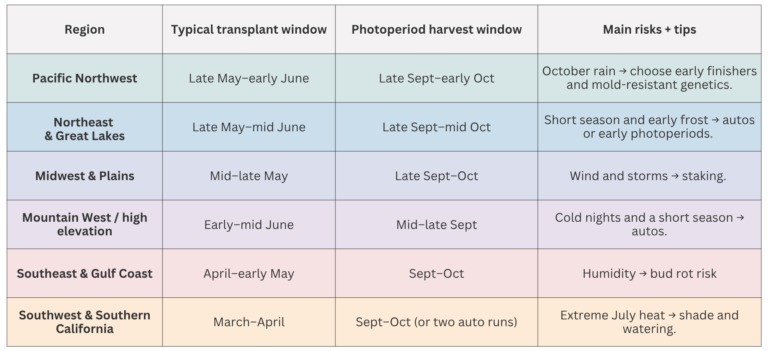
This table includes approximate ranges based on general horticulture advice. While these windows can serve as a good jumping-off point, we also recommend checking your local first and last frost dates for a closer estimate.
Additionally, this table only applies to the Northern Hemisphere; in the Southern Hemisphere, the seasons are flipped, meaning you should typically plant sometime in October or November and harvest sometime around March and April.
Last Frost Dates by City
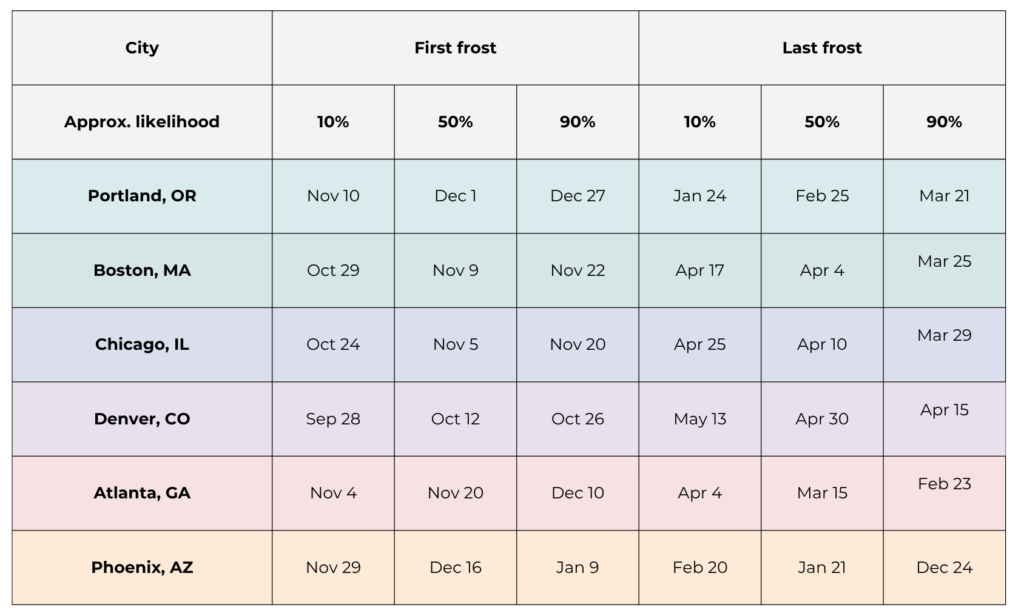
Note: This information is from the National Weather Association. We’ve included six cities in our chart below, but you can easily find dates for your precise location here.
You might notice that the last-frost dates in the chart below are much earlier than the recommended transplant windows mentioned in the regional chart. Meanwhile, the first-frost dates occur later than the recommended harvest windows covered earlier. For a crop like cannabis, the last-frost date is best treated as more of a parameter you shouldn’t plant before—not a green light to go ahead and plant your seeds. The first frost date can help growers understand when to harvest weed in their region, and is better viewed as a clear deadline, not necessarily an optimal harvest date.
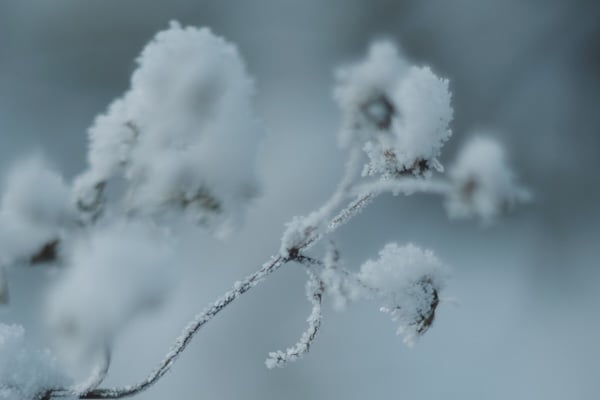
Image credit: Nadezhda Moryak
Why Are Last Frost Dates Helpful?
Frost dates help growers understand the length of their local outdoor growing season and plan accordingly. The last-frost date indicates when the risk of spring frost has mostly passed, not when it’s necessarily warm enough to plant cannabis outdoors. The first-frost date helps growers estimate when fall frost may threaten their plants. Together, these dates help approximate the number of frost-free days in a growing season.
Many growers will find that the optimal time to plant can occur weeks, or even a month or more, after the last-frost date. This is partly because a photoperiod cannabis plant’s growth stages correlate with changes in daylight. As a general guide, a plant receiving 12 hours or less of light each day will tend to flower, while one receiving 14 or more hours will favour vegetative growth.
If you start growing early in the year, daylight hours will first increase, then decrease as summer turns to fall. That’s why it’s safest to wait until days are consistently 14 hours or longer before planting outdoors. This gives your plants time to establish healthy vegetative growth before entering the flowering phase.
The easiest way to read this chart: When looking at these windows, remember that both last- and first-frost dates help you plan around the same thing: cultivating during the frost-free portion of your local growing season.
Image credit Francis Costelloe
Photoperiod vs Autoflower: How Planting Times Differ
Photoperiod and autoflowering cannabis follow different growing schedules, so understanding the timing can help you make the most of your outdoor season.
Photoperiod plants typically have one main growing window each spring. They spend June and July in the vegetative stage, then begin flowering as nights grow longer after the summer solstice. Flowering usually becomes visible by late July or August, with harvest taking place in September or October. Some late-flowering sativa varieties may need until November, which can be risky in cooler northern regions.
Autoflowering plants flower according to age rather than changes in daylight. They typically finish about 10–12 weeks after germination, so you can plant them after the last frost as long as roughly 75–90 frost-free days remain. In warmer regions, this shorter growing cycle may allow you to stagger two or three plantings, for example, in mid-May and early July.
Each type has its own trade-offs: photoperiods offer more control over the vegetative stage, while autoflowers can provide a faster, more flexible growing schedule. For a closer look, see our comparison of autoflower and feminized seeds.
Once your plants begin flowering, learn what to expect in the cannabis flowering stage.
When Is It Too Late to Plant Cannabis Outdoors?
Photoperiod cannabis planted after early July will generally still begin flowering as days shorten in late summer. However, with less time to grow before flowering begins, plants will be smaller, and harvests are likely to be lighter. For this reason, most growers in the US consider June to early July as a reasonable cutoff for planting photoperiod cultivars outside.
Autoflowers, on the other hand, have a shorter growing cycle, typically finishing about 10–12 weeks from seed. To allow roughly 90 frost-free days, count back three months from your area’s first-frost date. Using the National Gardening Association’s 10% first-frost dates, that means planting by around June 30 in Denver, late July in Chicago and Boston, and August in Atlanta, Portland, and Phoenix.
These are approximate planning dates, so check the frost dates for your own area. If you’re planting later in the season, a late autoflower or fast-flowering photoperiod may be worth considering. Explore our fast-flowering cannabis seed collection.
When to Start Cannabis Seeds Indoors
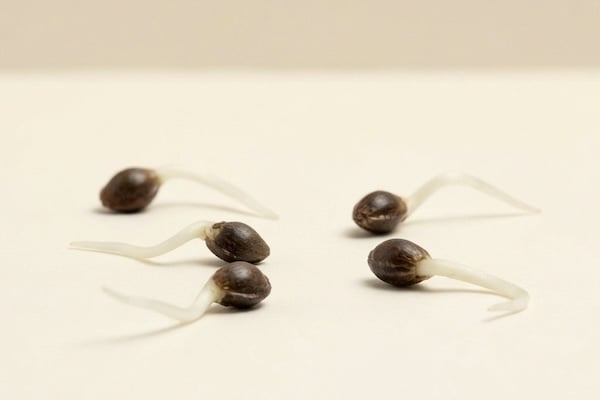
Even if you’re planning on growing weed outdoors, it’s usually best to start your photoperiod cannabis seeds indoors. Once you know when to put plants outside, count backward about 2–4 weeks before that date. This will help you determine the right time to germinate.
Starting indoors is beneficial because it gives seedlings a solid head start, while protecting them from early exposure to pests like slugs and birds. In other words, you’ll get the added benefits of a longer growing season while sidestepping the risks of planting too early.
Starting Autoflower Seeds
Autoflowers are a little different. Because they have a short, predetermined life cycle, transplanting can interrupt their growth and cost them valuable time. If possible, sow autoflower seeds directly into their final outdoor containers or planting spots. If you prefer to start them indoors, use biodegradable pots and transplant them while they’re still young, ideally within the first 1–2 weeks.
Let Your Seedlings Adjust Gradually to the Outdoor Climate
Growers are strongly encouraged to harden off indoor-grown seedlings before moving them outdoors permanently. Hardening off plants just means gradually introducing your young seedlings to outdoor conditions slowly, typically over a period of about seven days.
Begin by picking a sheltered, shady spot, then place your seedlings in this area, either directly on the ground or in a cardboard box. Leaving them outside for approximately 1-2 hours will allow them to gently adjust to the outdoor climate. Continue this process by slowly increasing their exposure to sunlight and outdoor temperatures in the days that follow.
By the end, they should be able to spend full days outdoors and, when nighttime temperatures are suitable, remain outside overnight. Skipping this transition can leave seedlings vulnerable to sunburn, wind damage, and transplant shock (University of Georgia Center for Urban Agriculture, 2026). For more on caring for young plants, see our cannabis seedling care guide and germination guide.
Image credit: Olena
How Long Does a Weed Plant Take to Grow Outside?
The time it takes for a weed plant to go from seed to harvest will depend on whether you’re cultivating a photoperiod or auto strain. Typically, the growing cycle for a photoperiod plant started in mid-May will look something like the following:
- Seedling: 2–3 weeks
- Vegetative growth: June and July
- Flowering: August through September or October
- Harvest: Late September or October
That’s roughly five to six months from seed to harvest, depending on the variety and growing conditions. Autoflowers, by contrast, have a much shorter growing cycle, typically taking around 8–10 weeks from seed to harvest.
One important thing to understand about outdoor photoperiods is that their flowering schedule can be influenced by seasonal changes in daylight, which vary depending on your location. Growers in colder, northern regions simply have a shorter window of time. Growers in areas where outdoor planting can begin earlier, such as the Southwest and Gulf Coast, can use an extended growing window to their advantage, providing their plants with more time to bulk up during the vegetative stage before flowering begins. In other words, the growing process isn’t inherently longer in warmer regions—but it can be, as extending the vegetative stage deliberately can encourage more robust growth.
Choosing Seeds That Fit Your Season
Knowing when to plant marijuana outdoors for your region isn’t just useful knowledge on its own; it can also help guide your strain choices. The best outdoor strains depend on your local climate and how long your growing season lasts. If you’re not sure where to start, the following categories may be a useful jumping-off point.
Short or Northern Growing Seasons
If you live in colder areas, such as the Pacific Northwest, New England, or the northern parts of the Midwest, you’ll typically have a shorter growing window overall. Aim for autoflowering or fast-flowering photoperiods, especially those that can be harvested in mid or late September. Choices like these will provide you with the best chance of harvesting before the cold autumn weather arrives.
Fat Banana and HulkBerry are two solid options: Both clock in at 27% THC and can typically be harvested in mid-to-late September. Shiskaberry is another fast-flowering, early harvest strain. As a 100% indica cultivar, it’s an especially smart pick for those who like heavy, sedating effects.
Purple Hulk Auto is a true speed demon of the cannabis world; some growers report it can transition from seed to fully-mature plant in as few as 65-75 days. While Amnesia Haze Auto is relatively slower, it’s also a sativa-dominant cultivar—and speed-wise, it does laps around its photoperiod counterpart.
Image credit: Fatih Güney
Wet Autumns
If you live in a humid or rainy area like the Pacific Northwest, the Gulf Coast, or the Southeast, mold-resistant strains offer a major advantage. Sativa lovers may want to aim for strains like Blue Dream, Durban Poison, or Trainwreck; these offer clear, energizing effects with the added benefit of above-average resilience against humidity-related issues. Growers looking for an autoflowering strain are encouraged to explore choices like Northern Lights Auto and Gorilla Glue Auto.
Long, Hot Growing Seasons
Areas like SoCal and the Southwest tend to have longer stretches of cannabis-friendly weather each year. This climate offers growers some added flexibility and provides a good opportunity to cultivate sativa-dominant strains that can benefit from a longer vegetative period. Some growers note that Green Crack fares especially well when it’s given plenty of time to bulk up before flowering begins. Tangie is another good option, especially for growers who prefer fragrant, old-school classics.
Image credit: Alan Cabello
Some Closing Thoughts
Growing weed outdoors can be a fulfilling process and becomes even more enjoyable with a little up-front planning. Doing some quick research on your local climate ahead of time can help provide a much clearer picture of when to plant your seeds.
Choosing the right strains in advance can also be a real game-changer. If you live in an area with shorter summers, autoflowers are a smart pick, as they tend to be especially efficient. If your region has longer, warmer seasons, you may want to take advantage of the additional time by choosing a strain that responds well to an extended vegetative stage.
No matter your location, exploring our outdoor cannabis seeds or autoflower seeds is a great place to start.
FAQs
Can I plant cannabis seeds directly in the ground outside?
Yes, you can plant cannabis seeds directly outdoors once the soil has warmed up and the risk of frost has passed. Keep in mind that young seedlings are vulnerable to slugs, birds, heavy rain, and other outdoor hazards. For this reason, many growers choose to start their seeds indoors; this approach offers a more protective environment.
What month should I put my cannabis plants outside?
It depends on where you live and how quickly your local temperatures warm up. As a general guide, May is a common planting month across much of the U.S., while northern and high-elevation areas may need to wait until June. In warmer regions, such as the Southwest and Southern California, outdoor planting can often begin as early as March or April.
Can I plant autoflowers outdoors in summer?
Absolutely. Autoflowers can be planted throughout the summer, provided you have enough frost-free weather left for the strain to mature. Roughly speaking, growers can expect the growing process to take somewhere between 75–90 days, but the individual strain’s description will provide a clearer estimate. During hot weather, keep an eye on soil moisture and protect young plants from excessive heat and intense afternoon sun.
What happens if I put my cannabis plant outside too early?
Cold nights and chilly soil can slow growth and stress young plants. There’s also a risk of confusing a photoperiod plant’s flowering cycle: if you plant before the days are long enough to provide 14 hours of consistent light, your plants can begin the flowering stage too soon, revert back to a vegetative state in response to the longer days that follow, and finally, attempt to flip back to the flowering stage again as the days become shorter near the end of summer.
When does cannabis start flowering outdoors?
Photoperiod cannabis plants typically begin flowering in late July or August in much of the U.S., as nights get longer and daylight hours fall below the strain’s critical threshold. The exact timing depends on your location and the genetics you’re growing. Autoflowers are different: they begin flowering according to age rather than changes in daylight. For a closer look at what to expect, read our guide on the cannabis flowering stage.
Is it legal to grow cannabis outdoors in my state?
That depends on where you live. States that permit home cultivation may still have rules about plant visibility, security, and where plants can be grown. Local rules may add further restrictions, including limits on outdoor growing. For this reason, it’s very important to check your state and local regulations before planting.
References
Alter, H., Sade, Y., Sood, A., Carmeli-Weissberg, M., Shaya, F., Kamenetsky-Goldstein, R., Bernstein, N., & Spitzer-Rimon, B. (2024). Inflorescence development in female cannabis plants is mediated by photoperiod and gibberellin. Horticulture Research, 11(11), uhae245. https://doi.org/10.1093/hr/uhae245
National Centers for Environmental Information. (2024, March 22). When to expect your last spring freeze. National Oceanic and Atmospheric Administration. https://www.ncei.noaa.gov/news/last-spring-freeze
National Gardening Association. (n.d.-a). Frost dates: First and last frost dates. Garden.org. https://garden.org/apps/frost-dates/
National Gardening Association. (n.d.-b). Frost dates: First and last frost dates for Atlanta, Georgia. Garden.org. https://garden.org/apps/frost-dates/Atlanta,%20Georgia/
National Gardening Association. (n.d.-c). Frost dates: First and last frost dates for Chicago, Illinois. Garden.org. https://garden.org/apps/frost-dates/Chicago,%20Illinois/
National Gardening Association. (n.d.-d). Frost dates: First and last frost dates for Denver, Colorado. Garden.org. https://garden.org/apps/frost-dates/Denver,%20Colorado/
National Gardening Association. (n.d.-e). Frost dates: First and last frost dates for Phoenix, Arizona. Garden.org. https://garden.org/apps/frost-dates/Phoenix,%20Arizona/
National Gardening Association. (n.d.-f). Frost dates: First and last frost dates for Portland, Oregon. Garden.org. https://garden.org/apps/frost-dates/Portland,%20Oregon/
National Weather Service. (n.d.). First and last dates for selected temperatures thresholds in Phoenix, Yuma, and El Centro. National Oceanic and Atmospheric Administration. https://www.weather.gov/psr/FirstandLastTemperatures
National Weather Service, Chicago, IL. (n.d.). Normal date of final spring freeze. National Oceanic and Atmospheric Administration. https://www.weather.gov/lot/lastfreeze
USFrostDates. (2026). Frost date sources and methodology. https://usfrostdates.com/methodology/

No Comments